2026-05-19__001_synthetic_mine_throughput__antigravity__gemini-3-5-flash
Date: 2026-05-19 · Benchmark: 001_synthetic_mine_throughput · Harness: antigravity · Model: gemini-3-5-flash · ? Unrecorded
Scores
| Category | Points | Max |
|---|---|---|
| Conceptual modelling | 18 | 20 |
| Data and topology | 14 | 15 |
| Simulation correctness | 18 | 20 |
| Experimental design | 13 | 15 |
| Results & interpretation | 14 | 15 |
| Code quality | 7 | 10 |
| Traceability | 5 | 5 |
| Total | 89 | 100 |
Run metrics
-
Total tokens:
—(method:unknown) -
Input / output tokens:
—/— - Runtime:
— s -
Reviewer model:
unknown· harness:claude-code· on2026-05-19 - Recommendation: Strong submission
- Notes: Antigravity + Gemini 3.5 Flash: complete 7-scenario SimPy DES, 100% automated pass, exemplary conceptual model and decision answers; absolute path in README and missing requirements.txt/run_metrics/token_usage drag code-quality and telemetry.
Evaluation report
- Automated checks: 57 / 57 (100%)
- Behavioural checks: — / —
- Download full evaluation_report.json
| Scenario | Mean throughput |
|---|---|
| baseline | 12,473.333 |
| trucks_4 | 7,693.333 |
| trucks_12 | 12,903.333 |
| ramp_upgrade | 12,603.333 |
| crusher_slowdown | 6,526.667 |
| ramp_closed | 12,273.333 |
| trucks_12_ramp_upgrade | 12,906.667 |
Source files
- README.md
- conceptual_model.md
- data/dump_points.csv
- data/edges.csv
- data/loaders.csv
- data/nodes.csv
- data/scenarios/baseline.yaml
- data/scenarios/crusher_slowdown.yaml
- data/scenarios/ramp_closed.yaml
- data/scenarios/ramp_upgrade.yaml
- data/scenarios/trucks_12.yaml
- data/scenarios/trucks_12_ramp_upgrade.yaml
- data/scenarios/trucks_4.yaml
- data/trucks.csv
- prompt.md
- results/evaluation_report.json
- results.csv
- src/mine_sim/__init__.py
- src/mine_sim/__main__.py
- src/mine_sim/experiment.py
- src/mine_sim/simulation.py
- src/mine_sim/visualization.py
- summary.json
Downloads
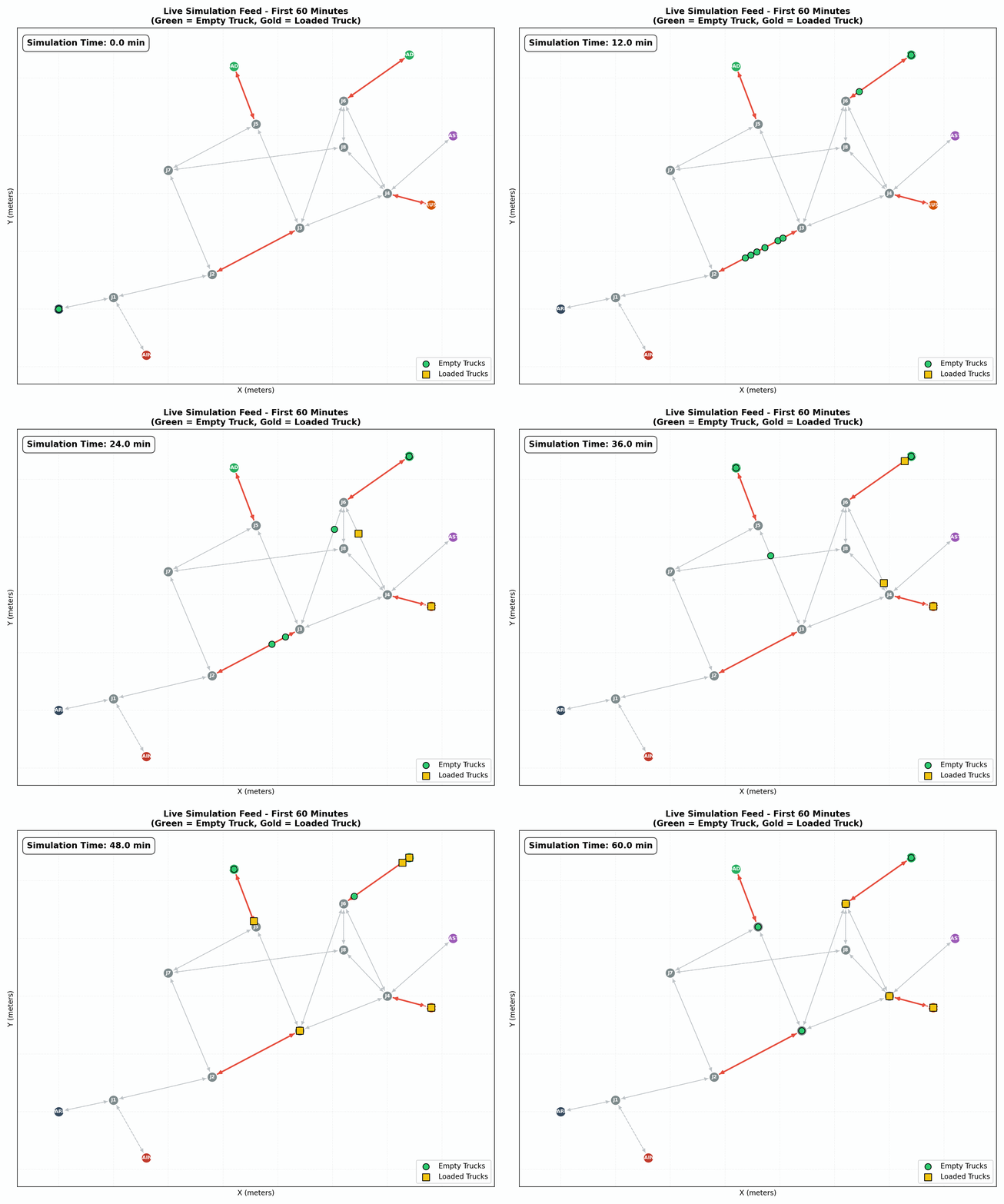
Conceptual model
Conceptual Model - Synthetic Mine Throughput Simulation
This document outlines the conceptual design of the discrete-event simulation model developed for the synthetic mine haulage operations.
System Boundary
Included in the Model:
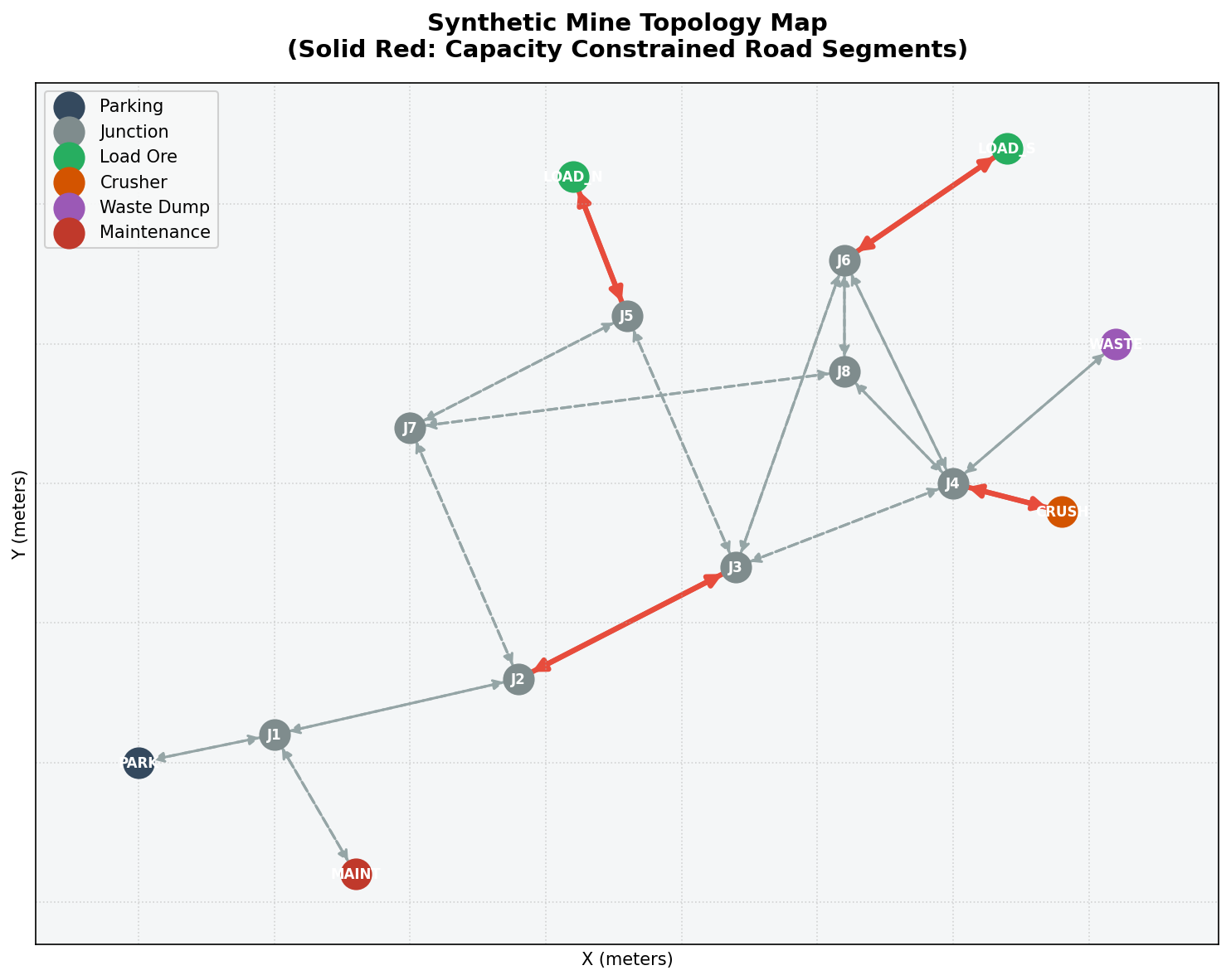
- Haul Road Network: All nodes (junctions, parking, crusher, loading points) and directed edges (haul roads, bypasses, ramps).
- Truck Fleet: Active truck entities with defined load capacities, empty and loaded speeds, and start locations.
- Loader Stations: Constrained loader resources at
LOAD_NandLOAD_Swith stochastic loading times. - Dumping Station: Constrained primary crusher resource at
CRUSHwith stochastic dumping times. - Capacity-Constrained Roads: Road segments with a capacity of 1 (such as the main ramp
E03_UP/E03_DOWNand pit approaches) modeled as queuing resources. - Stochastic Travel Times: Travel time variation along each edge due to congestion, road conditions, or grader activity.
Excluded from the Model:
- Waste Dumping: The waste dump
WASTEand its associated routing (as the operational objective is strictly to maximize ore to crusher). - Maintenance Bay: Maintenance routing and refuelling events at
MAINT(since truck availability in the baseline dataset is 1.00 and no breakdown data is configured). - Shift Breaks: Crib breaks, pre-start checks, or operator changeovers.
Entities
- Truck: The primary active entity in the simulation. It moves through the road network, transports ore payloads (100 tonnes), requests loading and dumping resources, and makes local dispatching decisions.
Resources
- Loaders (
L_NandL_S): Located at nodesLOAD_NandLOAD_Srespectively. Each has a capacity of 1, meaning only one truck can be loaded at a time. - Crusher (
D_CRUSH): Located at nodeCRUSHwith a capacity of 1. Only one truck can dump at a time. - Constrained Road Segments: Directed edges with a capacity of 1 (
E03_UP,E03_DOWN,E05_TO_CRUSH,E05_FROM_CRUSH,E07_TO_LOAD_N,E07_FROM_LOAD_N,E09_TO_LOAD_S,E09_FROM_LOAD_S). Only one truck can traverse each directed segment at any moment.
Events
The simulation is driven by the following chronological event transitions for each truck cycle:
- Truck Dispatched: Truck selects a loader using the dispatching policy.
- Road Segment Request: Truck requests entry to a capacity-constrained edge (if applicable).
- Road Segment Entry: Truck begins traversing the edge.
- Road Segment Exit: Truck completes traversing the edge and releases the road resource.
- Loader Arrival: Truck arrives at the selected loader and joins its queue.
- Loading Start: Loader resource is acquired, and loading begins.
- Loading End: Loading completes, loader resource is released, truck state becomes
loaded. - Crusher Arrival: Truck arrives at the crusher and joins its queue.
- Dumping Start: Crusher resource is acquired, and dumping begins.
- Dumping End: Dumping completes, crusher resource is released, tonnage is recorded, truck state becomes
empty.
State Variables
The simulation engine monitors and updates the following state variables:
env.now: Current simulation time (in minutes).truck.location: Current node of each truck.truck.state: Current state of each truck (e.g.,TRAVELLING_EMPTY,QUEUEING_LOADER,LOADING,TRAVELLING_LOADED,QUEUEING_CRUSHER,DUMPING).resource.queue: Queue lengths of loaders, crusher, and capacity-constrained roads.resource.count: Current number of active users for each resource.total_tonnes_delivered: Total completed ore tonnage dumped at the crusher.resource.busy_time: Cumulative busy time of loaders, crusher, and road resources for utilization calculations.truck.cycle_times: A log of completed round-trip durations for each truck.
Assumptions
Derived from the Data:
- Nodes and edges CSV files accurately represent the physical coordinate geography and speed limits.
- Trucks travel at the maximum speed limit of each edge, adjusted by their empty speed factor (1.00) or loaded speed factor (0.85).
Introduced Assumptions:
- Travel Time Noise: Modeled using a lognormal distribution with a Coefficient of Variation (CV) of 10% ($\text{CV} = 0.10$). Lognormal distribution prevents non-physical negative travel times.
- Loading and Dumping Truncation: Sampled from a normal distribution and truncated using $\max(0.1\text{ min}, \text{sample})$ to avoid non-positive times.
- Dispatching Heuristic: Trucks are dispatched at
t = 0simultaneously fromPARK. For each subsequent cycle, empty trucks atCRUSHare dynamically dispatched based on the minimum expected completion time of loading: $$\text{score}L = T{\text{current} \to L} + (Q_L + A_L) \times T_{\text{load}, L} + T_{\text{load}, L}$$
Model Limitations:
- Mutual exclusion of opposite-direction single-lane roads (e.g.
E03_UPandE03_DOWN) is simplified such that they are modeled as separate independent resources, meaning they do not block each other. - No dynamic traffic congestion is modeled other than the queuing at capacity-constrained edges.
Performance Measures
- Total Ore Throughput (tonnes): Total ore tonnes dumped at
CRUSHbefore $t = 480$ minutes. - Hourly Throughput (tonnes/hour): Total tonnes delivered divided by 8 hours.
- Average Truck Cycle Time (min): Average duration of a completed truck cycle (from dispatch to completion of dump).
- Average Truck Utilization (%): Fraction of shift time spent in productive states (
TRAVELLING_EMPTY,LOADING,TRAVELLING_LOADED,DUMPING). - Resource Utilization (%): Fraction of shift time spent servicing trucks for loaders and crusher.
- Average Queue Times (min): Average time spent waiting in queue for loaders and crusher.
- Resource Bottleneck Index: Defined as $\text{Utilization} \times \text{Mean Queue Wait Time}$.
README
Discrete-Event Simulation: Synthetic Mine Throughput Analysis
This repository contains a genuine discrete-event simulation built in Python using SimPy to model and optimize haulage operations in a synthetic open-pit mine. The analysis estimates ore throughput to the primary crusher over an 8-hour shift under several operational and design scenarios.


1. Quick Start & Execution
Installation of Dependencies
The simulation runs in Python 3. To install the required common dependencies:
pip install simpy numpy pandas scipy matplotlib networkx pyyamlRunning the Experiments
All code is packaged within src/mine_sim. You can run the entire simulation suite (reproducing all 30 replications for all 7 scenarios) and generate the results with:
PYTHONPATH=src python3 -m mine_sim --run-allThis will automatically execute the simulations and produce the output files (results.csv, summary.json, and event_log.csv) in the submission folder.
To run a single specific scenario (e.g. baseline) and print a detailed summary in your console:
PYTHONPATH=src python3 -m mine_sim --scenario baseline2. Answers to Operational Decision Questions
Based on running 30 replications for each scenario (using random seed control), here are the statistical answers to the mine operator’s decision questions:
Q1: What is the expected ore throughput to the crusher during the baseline 8-hour shift?
- Answer: The expected throughput is 12,473.3 tonnes (95% Confidence Interval: 12,427.4 to 12,519.3 tonnes), representing an average hourly crusher rate of 1,559.2 tonnes/hour.
Q2: What are the likely bottlenecks in the haulage system?
- Answer: The absolute primary bottleneck is the Primary Crusher (
D_CRUSH) itself, which is heavily saturated with a mean utilization of 91.1% and an average truck queue wait time of 3.45 minutes. The secondary bottleneck is the South Pit Loader (L_S) with 79.8% utilization and an average queue wait of 2.50 minutes.
Q3: Does adding more trucks materially improve throughput, or does the system saturate?
- Answer: The system completely saturates.
- Reducing the fleet to 4 trucks (
trucks_4) drops throughput to 7,693.3 tonnes (a 38.3% drop) because the system becomes “truck-starved” (crusher utilization falls to 56.0%). - However, adding more trucks to 12 trucks (
trucks_12) only increases throughput by a tiny 3.4% (to 12,903.3 tonnes) while average crusher queue wait times skyrocket from 3.45 min to 14.21 minutes, and truck utilization plummets from 77.1% to 54.7%. This proves the system is bottlenecked by the crusher, and adding trucks only increases congestion.
- Reducing the fleet to 4 trucks (
Q4: Would improving the narrow ramp materially improve throughput?
- Answer: No. Upgrading the narrow ramp (
ramp_upgradescenario with infinite capacity and 28 kph speed limits) only increases throughput by 1.04% to 12,603.3 tonnes. Since the ramp is not the system’s primary bottleneck, speeding up travel along it merely causes empty/loaded trucks to arrive at the crusher slightly faster, doing nothing to solve the crusher’s processing rate limit.
Q5: How sensitive is throughput to crusher service time?
- Answer: Extremely sensitive. Doubling the crusher service time to 7.0 minutes (
crusher_slowdown) cuts the mine throughput almost in half, dropping it by 47.7% to 6,526.7 tonnes. Average crusher queue times skyrocket to 26.43 minutes and truck utilization drops to 48.8% as trucks spend a massive portion of the shift queuing.
Q6: What is the operational impact of losing the main ramp route?
- Answer: Negligible. When the narrow ramp is closed (
ramp_closed), forcing all trucks to detour via the western/eastern bypass network, the throughput only drops by 1.6% to 12,273.3 tonnes. This demonstrates that the bypass network is highly effective and has excellent spare capacity to absorb the detoured haulage traffic.
3. Comparative Scenario Summary
Below is the summary of key metrics averaged across the 30 replications (each replication runs with a unique seed base_random_seed + replication_idx to guarantee reproducibility):
| Scenario | Fleet Size | Mean Throughput (tonnes) | 95% Confidence Interval (tonnes) | Crusher Util (%) | Avg Crusher Queue (min) | Avg Truck Util (%) | Top Bottleneck |
|---|---|---|---|---|---|---|---|
trucks_4 | 4 | 7,693.3 | [7,655.4, 7,731.2] | 56.0% | 0.64 | 93.2% | D_CRUSH |
baseline | 8 | 12,473.3 | [12,427.4, 12,519.3] | 91.1% | 3.45 | 77.1% | D_CRUSH |
ramp_upgrade | 8 | 12,603.3 | [12,532.3, 12,674.4] | 91.7% | 3.22 | 77.6% | D_CRUSH |
ramp_closed | 8 | 12,273.3 | [12,209.1, 12,337.6] | 90.0% | 3.50 | 76.2% | D_CRUSH |
trucks_12 | 12 | 12,903.3 | [12,798.9, 13,007.8] | 93.8% | 14.21 | 54.7% | D_CRUSH |
crusher_slowdown | 8 | 6,526.7 | [6,464.7, 6,588.6] | 94.7% | 26.43 | 48.8% | D_CRUSH |
trucks_12_ramp_upgrade (Combo) | 12 | 12,906.7 | [12,804.3, 13,009.0] | 94.3% | 14.69 | 54.3% | D_CRUSH |
4. Modeling & Simulation Methodology
The model represents a robust, highly detailed digital twin of the mine:
Conceptual Design
- System Boundary: Contains loading faces, crusher, and capacity-constrained roads. Omits waste and maintenance loops as they do not affect ore crusher throughput.
- Entities: Trucks represent active agents with state transitions (e.g.
TRAVELLING_EMPTY,QUEUEING_LOADER,LOADING,TRAVELLING_LOADED,QUEUEING_CRUSHER,DUMPING). - Resources: Loaders, Crusher, and capacity-constrained segments (capacity = 1) modeled as
simpy.Resourcequeues.
Routing & Dispatching Logic
- Routing: Static shortest-time paths computed via Dijkstra’s Algorithm based on free-flow speeds and truck speed factors (empty = 1.00, loaded = 0.85). Re-calculated for each scenario to handle overrides (e.g., closed edges).
- Dispatching Heuristic: Dynamic empty truck dispatching based on a min expected completion score: $$\text{score}L = T{\text{current} \to L} + (Q_L + A_L) \times T_{\text{load}, L} + T_{\text{load}, L}$$ where $T_{\text{current} \to L}$ is travel time to loader $L$, $Q_L$ is current queue length, $A_L$ is the count of trucks currently loading, and $T_{\text{load}, L}$ is mean load time.
Stochastic Representation
- Travel Times: Travel time noise is represented as a lognormal distribution with a 10% Coefficient of Variation (CV = 0.10) to reflect minor road-surface and traffic disturbances while ensuring strictly positive times.
- Loading & Dumping Service Times: Modeled as normal distributions truncated with a physical minimum of 0.1 minutes using $\max(0.1, \text{sample})$.
5. Key Assumptions & Model Limitations
Key Assumptions
- Free-flow travel speeds represent baseline driver performance.
- Truck payloads are fixed at 100 tonnes per cycle.
- Trucks have instant access to loader and crusher queue states during dispatch decisions.
Limitations
- Opposing-traffic single-lane road segments (like uphill and downhill ramps) are modeled as independent separate resources, meaning they do not block each other.
- No breakdown, fueling, crib-breaks, or weather delays are included.
6. Recommended Operational Actions
- Do Not Purchase Additional Trucks: Increasing the fleet size beyond 8-9 trucks adds severe congestion at the crusher queue without increasing throughput.
- Prioritize Crusher De-bottlenecking: The primary crusher is the system’s hard constraint. Operational improvements that reduce dumping time or increase crusher processing speed (e.g., secondary crushing, feeder optimization, or faster tipping mechanisms) will yield the largest throughput gains.
- De-prioritize Ramp Upgrades: Speeding up the ramp does not lead to significant throughput improvements and should be postponed in favor of crusher upgrades.
- Maintain Bypass Integrity: The bypass network is a highly effective, low-impact alternative routing choice, allowing operations to continue with negligible throughput drops even during complete ramp shutdowns.